As an Amazon Associate we earn from qualifying purchases. Product links on this page may be affiliate links.
Last reviewed: November 2026. Sources and prices checked November 2, 2026. We have not tested these power stations: specs are what each maker states, and the runtimes below are our arithmetic, not measurements.
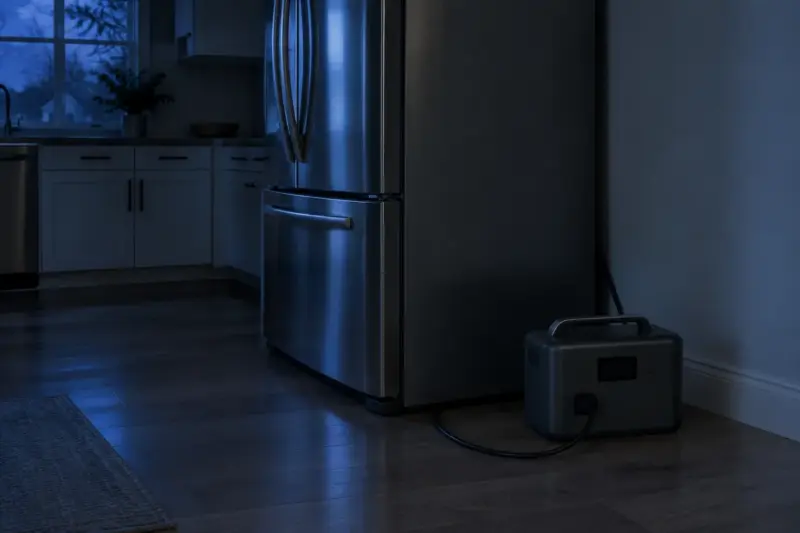
Two numbers decide it. The station's surge rating has to cover the moment the compressor starts, and its capacity in watt-hours decides how long the fridge keeps running. Honda estimates 1,200 starting watts for an ENERGY STAR refrigerator, and every station in our table is rated well above that. For capacity, an average refrigerator-freezer uses about 1.6 kWh a day by the Department of Energy's figure, so with Jackery's own runtime formula a station of about 1,000 Wh covers roughly half a day and one of about 2,000 Wh roughly a full day. The yearly kWh on your fridge's yellow EnergyGuide label lets you do the same math for your model.
Table of Contents
Step 1: surge watts, for the moment the compressor starts
A refrigerator does not draw steady power. ENERGY STAR explains that "in a typical refrigerator, the compressor is simply on or off," and the Department of Energy puts the "average on/off cycling time" of a conventional fridge at "about 30 minutes (i.e., 48 cycles per day)." Every one of those starts pulls far more power for a moment than the fridge uses while running.
| Source | Refrigerator starting watts | Running watts |
|---|---|---|
| Honda (ENERGY STAR refrigerator or freezer) | 1,200 W | 132–192 W |
| Champion (refrigerator) | 800–1,200 W | 150–400 W |
Jackery, which makes power stations, describes the same thing from the battery side: the startup surge is "typically 2 to 3 times the running wattage," and "if the surge exceeds the power station's peak output, the compressor will not start, or the power station will trip its overload protection and shut off." So compare the station's surge or peak rating, not just its continuous output, with the starting watts above. Both are estimates; your fridge may differ.
Step 2: watt-hours, for how long it runs
Start with your own fridge. The yellow EnergyGuide label lists "the average amount of energy the appliance will use a year," and for refrigerators it states it in kWh per year, according to the Energy Information Administration. Divide that number by 365 for your daily use. If you don't have the label, the Department of Energy says that, on average, consumer refrigerators, refrigerator-freezers and freezers "consume 384 kWh, 588 kWh, and 555 kWh per year, respectively" (2016 figures), and another DOE page puts typical household refrigerators at "1.5–2.0kWh of electricity per day."
Then use the maker's runtime formula. Jackery's is "Estimated Runtime (hours) = Capacity (Wh) × 0.85 ÷ Running Wattage of the Fridge," where "the 0.85 factor accounts for the natural energy conversion efficiency loss during use." Jackery adds two ways to use it: running watts give a conservative estimate, because "this assumes the compressor runs continuously," while you should "use average draw for a realistic runtime estimate."
Here is that arithmetic for an average refrigerator-freezer (588 kWh a year, which works out to an average draw of about 67 W), and for the worst case of Honda's top running figure (192 W) with the compressor never cycling off:
| Station capacity | Usable at 0.85 | At the average draw (67 W) | If the compressor never stopped (192 W) |
|---|---|---|---|
| About 1,000 Wh (1,024–1,152 Wh) | 870–979 Wh | About 13–15 hours | About 4.5–5 hours |
| About 2,000 Wh (2,042–2,048 Wh) | About 1,740 Wh | About 26 hours | About 9 hours |
| 3,072 Wh | About 2,610 Wh | About 39 hours | About 13.6 hours |
By the same formula, a full day at the average draw needs about 1,900 Wh of capacity. A newer, more efficient fridge needs less and an older or larger one more, which is why your own label beats any average. If you want the real figure, a smart plug with energy monitoring will show what your fridge actually draws.
How long food stays safe if the fridge stops
A station does not have to bridge every outage. The FDA says "the refrigerator will keep food cold for about 4 hours if it is unopened," and USDA FSIS says "a full freezer will hold the temperature for approximately 48 hours (24 hours if it is half full)." FSIS also says to keep an appliance thermometer in both and to make sure "the refrigerator temperature is at 40 °F or below." For a short outage, keeping the doors shut may be all you need; the station matters when the power stays off longer than that.
→ Appliance thermometers on Amazon
Six power stations that can run a refrigerator
Every station below lists a surge rating of 2,700 W or more, above the starting-watt estimates from Honda and Champion. Specs and prices are from each maker's site on November 2, 2026; sale prices change often.
| Station | Capacity | Continuous AC | Surge | Battery | Price on maker's site, Nov 2, 2026 |
|---|---|---|---|---|---|
| EcoFlow DELTA 3 Classic | 1,024 Wh | 1,800 W | 3,600 W | LFP | $479 |
| Jackery Explorer 1000 v2 | 1,070 Wh | 1,500 W | 3,000 W | LiFePO4 | $559 |
| BLUETTI AC180 | 1,152 Wh | 1,800 W | 2,700 W | LiFePO4 | $449 (out of stock; Bluetti expects it back in late November) |
| Jackery Explorer 2000 v2 | 2,042 Wh | 2,200 W | 4,400 W | LFP | $999 |
| EcoFlow DELTA 3 Max Plus | 2,048 Wh | 3,000 W | 6,000 W | LFP | $1,149 (regular $1,599) |
| EcoFlow DELTA 3 Ultra | 3,072 Wh | 3,600 W | 7,200 W | LFP | $1,299 |
→ EcoFlow DELTA 3 Classic · Jackery Explorer 1000 v2 · BLUETTI AC180 · Jackery Explorer 2000 v2 · EcoFlow DELTA 3 Max Plus · EcoFlow DELTA 3 Ultra
Which size fits
- Outages of a few hours: you may not need a station for the fridge at all; keep the doors shut and check the thermometer.
- Overnight, about 12 hours: a station of about 1,000 Wh, by the arithmetic above for an average fridge-freezer.
- A full day: about 2,000 Wh.
- Longer, or the fridge plus other things: a larger station, a way to recharge it, or a generator. We compare the two in power station vs gas generator.
If the station also has to keep your internet up, add the router and modem to the math: see how to keep Wi-Fi and your smart home running in an outage.
FAQ
Can a 1,000-watt power station run a refrigerator?
The 1,000-watt figure is not the one to check. What matters is the surge rating against the fridge's starting watts (Honda estimates 1,200 W for an ENERGY STAR model) and the capacity in watt-hours for how long it lasts.
How long will a 2,000 Wh power station run a refrigerator?
By Jackery's formula, about 26 hours for a fridge-freezer using the DOE average of 588 kWh a year, and about 9 hours in the worst case of a compressor that never cycles off at 192 W. Your fridge's label gives a closer figure.
How do I find my refrigerator's power use?
Read the yearly kWh on its yellow EnergyGuide label and divide by 365, or measure it with a smart plug that monitors energy.
Sources
U.S. Department of Energy: consumer refrigeration products FAQ and high-efficiency refrigerator project. ENERGY STAR: energy-efficient refrigerators. EIA: EnergyGuide labels. FDA: food and water safety during power outages. USDA FSIS: keep your food safe during emergencies. Honda: generator wattage estimation guide. Champion: generator wattage chart. Jackery: how many watts a refrigerator uses and how to keep a fridge cold without power. Station specs: EcoFlow DELTA 3 Classic, Jackery Explorer 1000 v2, BLUETTI AC180, Jackery Explorer 2000 v2, EcoFlow DELTA 3 Max series and EcoFlow DELTA 3 Ultra series.
Sources last checked November 2, 2026.
If you'd like to read other articles similar to What Size Portable Power Station Do You Need to Run a Refrigerator? You can visit the category Smart Energy.
You may also enjoy reading