As an Amazon Associate we earn from qualifying purchases. Product links on this page may be affiliate links.
Last reviewed: November 2026. Sources and prices checked November 2, 2026. We have not tested these products: specs are what each maker states, and the energy-per-tank figure below is our arithmetic from Honda's run times.
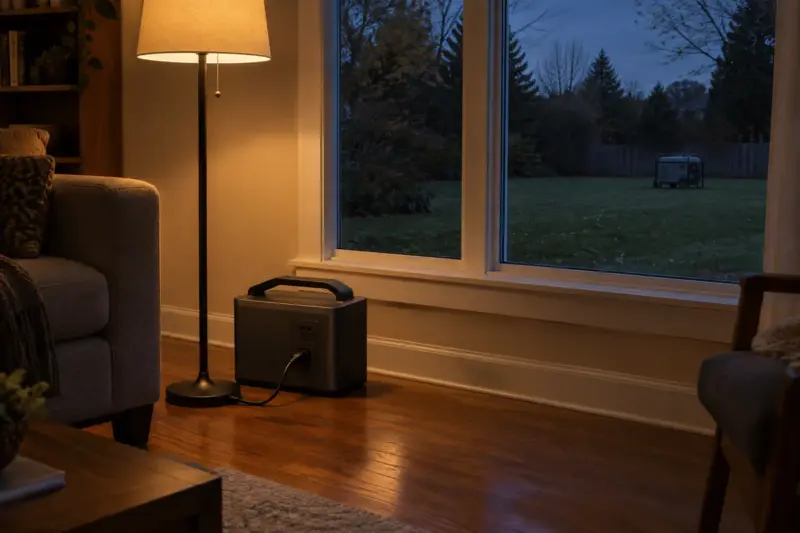
A portable power station has no engine and no exhaust, so you can run it indoors and it is quiet, but it holds a fixed amount of energy and has to be recharged. A gas generator keeps producing power as long as you refuel it, but it can only run outdoors, at least 20 feet from the house, because of carbon monoxide. For a refrigerator, internet and lights through an outage of a day or so, a power station of 1,000 to 2,000 Wh covers it. For outages of several days or bigger loads, a generator used outdoors does more, and wiring either one into the house is a job for a qualified electrician.
Table of Contents
The safety difference that decides it
The CPSC says "more than 100" of the yearly U.S. deaths from accidental carbon monoxide poisoning linked to consumer products "are linked to portable generators." Its 2023 report counts "872 fatalities from 699 incidents during 2012-2022," with "749 fatalities (86%)" associated with generators alone. The rules that follow from that:
- Never indoors, never in the garage. CPSC: "Never use portable generators inside homes or garages, even if doors and windows are open."
- Keep it far from the house. CPSC says to use generators "at least 20 feet away from homes with exhaust facing away"; the CDC says "more than 20 feet away from your home, doors, and windows."
- Install CO alarms. CPSC: "Install battery-operated CO alarms or plug-in CO alarms with battery back-up in your home."
Some newer generators shut themselves off when CO builds up. Honda says that "beginning in 2020, we are equipping all Honda portable generators" with its CO-MINDER system, which will "automatically shut down the generator before carbon monoxide levels near the generator reach a dangerous level." Champion, whose CO Shield does the same, warns that it "is not a substitute for an indoor carbon monoxide alarm or for safe operation." Don't assume every generator has it: in 2022 the CPSC found that although "both standards require generators to shut off when certain concentrations of CO are present around the generator," conformance with one of them "appears to be minimal."
A power station has no combustion, so none of that applies. Makers sell them for indoor use: EcoFlow describes charging its DELTA 3 Classic "whether indoors, outdoors, or on the move," and Bluetti says its AC180 is "designed for both indoor and outdoor scenarios." They do have temperature limits. Jackery lists the Explorer 1000 v2 for charging at 32–113 °F and for use at 14–113 °F, so a cold garage in winter can be outside its range.
Side by side
| Honda EU2200i (gas inverter generator) | EcoFlow DELTA 3 Classic | Jackery Explorer 1000 v2 | EcoFlow DELTA 3 Ultra | |
|---|---|---|---|---|
| Running output | 1,800 W rated | 1,800 W | 1,500 W | 3,600 W |
| Peak | 2,200 W max | 3,600 W surge | 3,000 W surge | 7,200 W surge |
| Energy | 0.95 gal tank: 3.2 h at rated load, 8.1 h at 1/4 load | 1,024 Wh | 1,070 Wh | 3,072 Wh |
| Noise (maker) | 57 dB(A) at rated load, 48 dB(A) at 1/4 load | ≤30 dB at 600 W | 30 dB | Not stated on the page we read |
| Refill or recharge (maker) | Refuel with gasoline | 0–80% in 45 minutes on AC | "Emergency Super Charge" 0–100% in 50 minutes | 0–80% in 89 minutes on AC or a generator |
| Where it can run | Outdoors only, 20+ ft from the house | Indoors or outdoors | Indoors or outdoors, within its temperature range | Indoors or outdoors |
| Price on maker's site, Nov 2, 2026 | MSRP $1,199 | $479 | $559 | $1,299 |
One tank shows the gap in stored energy. From Honda's own run times, the EU2200i delivers about 5.8 kWh per tank at its 1,800 W rating (1,800 W for 3.2 hours) and about 3.6 kWh at a quarter of it (450 W for 8.1 hours). That is our arithmetic, but it is several times what a 1,024 Wh station holds, and you can refill the tank, while a station needs a working outlet, a car or the sun to recharge.
→ Honda EU2200i · EcoFlow DELTA 3 Classic · Jackery Explorer 1000 v2 · EcoFlow DELTA 3 Ultra · CO alarms
Which one fits your outages
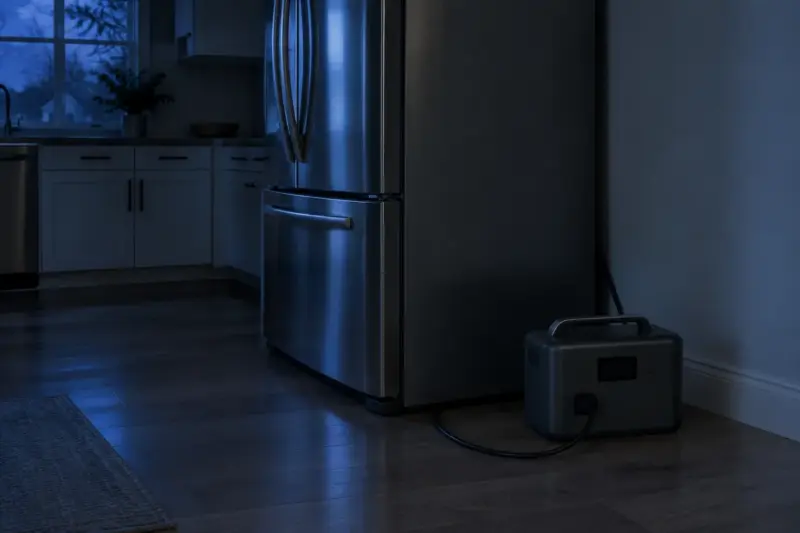
- A few hours to about a day, essentials only (refrigerator, router, lights, phones): a power station. See what size a refrigerator needs and how to keep Wi-Fi and your smart home running.
- Several days: a generator, run outdoors by the rules above, or a station you can recharge some other way.
- No safe outdoor spot 20 feet from the house (an apartment, a small lot): a power station.
- Running house circuits, not just plugged-in appliances: that needs a transfer switch installed by a qualified electrician, whichever you use.
Connecting either one
Plug appliances into the unit itself. For a generator outside, CPSC says to use "heavy-duty extension cords" made for outdoor use, with a wattage rating that "exceeds the total wattage of all appliances connected to it." Never plug a generator into a wall outlet. CPSC calls that backfeeding and says it "presents an electrocution risk to utility workers and neighbors served by the same utility transformer." OSHA's rule is to never attach a generator to a building's wiring "unless a qualified electrician has properly installed the generator with a transfer switch."
Storing generator fuel
CPSC: "Never store fuel for your generator in the home," and keep gasoline in "properly-labeled, non-glass safety containers" outside living areas. Turn the generator off and let it cool before refueling. Honda recommends that you "add fuel stabilizer according to the manufacturer's instructions when you fill the container with fresh fuel," and notes that "fuel stabilizers will not reconstitute stale fuel."
FAQ
Can I run a generator in the garage with the door open?
No. CPSC says never to use a portable generator inside a home or garage, "even if doors and windows are open."
Can a portable power station be used indoors?
Yes. It has no exhaust, and makers such as EcoFlow and Bluetti market theirs for indoor use. Keep it within the maker's temperature range.
Is a power station better than a generator for a power outage?
For short outages and essentials, it is quieter and can run indoors. For long outages or larger loads, a generator holds more energy per tank and can be refueled, as long as it runs outdoors.
Sources
CPSC: Carbon Monoxide Information Center, portable generator safety alert, 2023 generator CO fatalities report and 2022 release on CO shutoff standards. CDC: generator safety. OSHA: portable generator safety. Honda: EU2200i, CO-MINDER and fuel recommendations. Champion: 2500-watt inverter with CO Shield. Power stations: EcoFlow DELTA 3 Classic, EcoFlow DELTA 3 Ultra series, Jackery Explorer 1000 v2 and BLUETTI AC180.
Sources last checked November 2, 2026.
If you'd like to read other articles similar to Portable Power Station vs Gas Generator for Home Backup You can visit the category Smart Energy.
You may also enjoy reading